RoboMME: Benchmarking and Understanding Memory for Robotic Generalist Policies

Anonymous Authors
Under Review
RoboMME Benchmark Overview
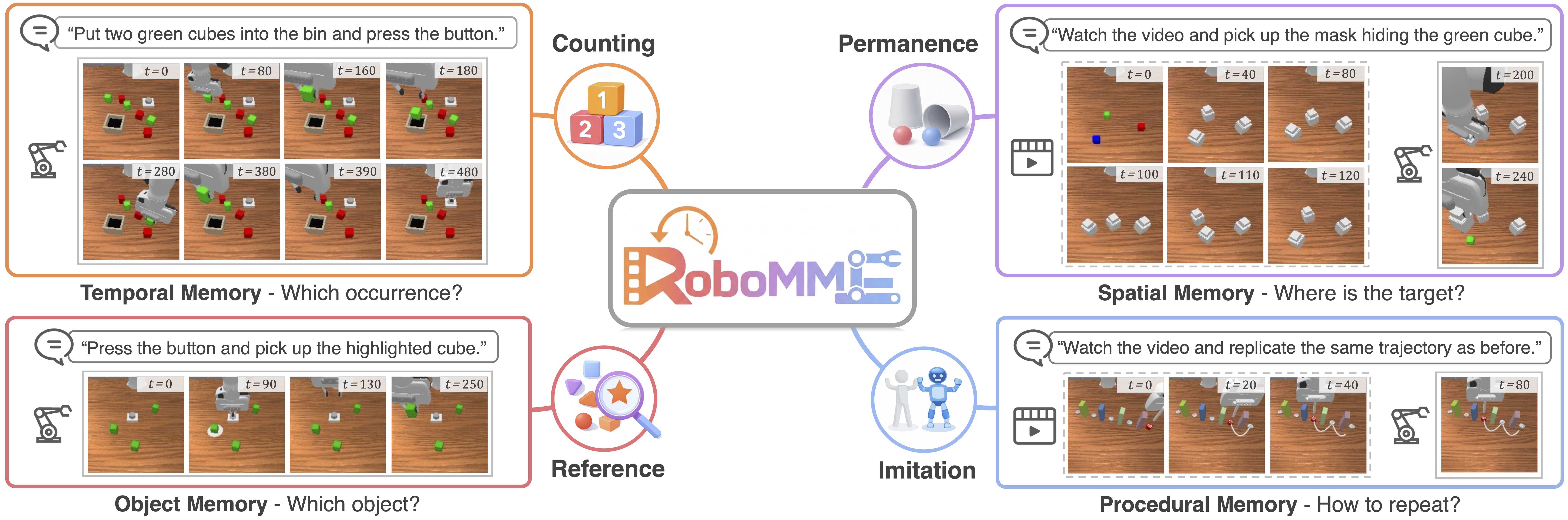
RoboMME is a large-scale, cognitively-motivated Robotic benchmark for Memory-augmented Manipulation Evaluation, comprising four task suites that emphasize distinct memory demands. (1) The Counting task suite targets temporal memory, requiring robots to accumulate and reason over past events, e.g., counting placed green cubes and stopping correctly (top-left). (2) The Permanence task suite focuses on spatial memory, requiring tracking of object locations under occlusion and environmental changes, e.g., resolving the correct mask after green and blue cubes swap positions (top-right). (3) The Reference task suite evaluates object memory, requiring identification under varied referential cues, e.g., recalling a briefly highlighted cube during a button press (bottom-left). (4) The Imitation task suite assesses procedural memory, measuring the ability to reproduce previously demonstrated behaviors, e.g., replicating a demonstrated trajectory (bottom-right). Overall, RoboMME includes 16 tasks with 773k high-quality training timesteps for systematic evaluation of memory-augmented robotic generalist policies.

Abstract

Memory is critical for long-horizon and history-dependent robotic manipulation. Such tasks often involve counting repeated actions or manipulating objects that become temporarily occluded. Recent vision-language-action (VLA) models have begun to incorporate memory mechanisms; however, their evaluations remain confined to narrow, non-standardized settings. This limits their systematic understanding, comparison, and progress measurement. To address these challenges, we introduce RoboMME: a large-scale standardized benchmark for evaluating and advancing VLA models in long-horizon, history-dependent scenarios. Our benchmark comprises 16 manipulation tasks constructed under a carefully designed taxonomy that evaluates temporal, spatial, object, and procedural memory. We further develop a suite of 14 memory-augmented VLA variants built on the π0.5 backbone to systematically explore different memory representations across multiple integration strategies. Experimental results show that the effectiveness of memory representations is highly task-dependent, with each design offering distinct advantages and limitations across different tasks.

RoboMME Task Examples

Task 1.1: BinFill
Instruction: Put two green cubes into the bin and press the button to stop.
Task 1.2: PickXtimes
Instruction: Pick up the blue cube and place it on the target, repeating this pick-and-place action three times, then press the button to stop.
Task 1.3: SwingXtimes
Instruction: Pick up the red cube, move it to the right-side target and then to the left-side target, repeating this right-to-left swing motion three times, then put down the cube and press the button to stop.
Spatial directions (e.g., left/right) follow the robot base coordinate frame.
Task 1.4: StopCube
Instruction: Press the button to stop the cube exactly at the target on its third visit.
Task 2.1: VideoUnmask
Instruction: Watch the video carefully, then pick up the container hiding the green cube.
Red-bordered frames denote the video-based initial observation prior to execution.
Task 2.2: ButtonUnmask
Instruction: First press the button, then pick up the container hiding the green cube, finally pick up another container hiding the red cube.
Task 2.3: VideoUnmaskSwap
Instruction: Watch the video carefully, then pick up the container hiding the blue cube, finally pick up another container hiding the red cube.
Red-bordered frames denote the video-based initial observation prior to execution.
Task 2.4: ButtonUnmaskSwap
Instruction: First press both buttons on the table, then pick up the container hiding the red cube.
Task 3.1: PickHighlight
Instruction: First press the button, then pick up all highlighted cubes, finally press the button again to stop.
Task 3.2: VideoRepick
Instruction: Watch the video carefully, then pick up the same cube that was previously picked up for two times, finally press the button to stop.
Red-bordered frames denote the video-based initial observation prior to execution.
Task 3.3: VideoPlaceButton
Instruction: Watch the video carefully and place the blue cube on the target where it was placed immediately before the button was pressed.
Red-bordered frames denote the video-based initial observation prior to execution.
Task 3.4: VideoPlaceOrder
Instruction: Watch the video carefully and place the green cube on the third target where it was placed.
Red-bordered frames denote the video-based initial observation prior to execution.
Task 4.1: MoveCube
Instruction: Watch the video carefully, then move the cube to the target in the same manner shown in the video.
Red-bordered frames denote the video-based initial observation prior to execution.
Task 4.2: InsertPeg
Instruction: Watch the video carefully, then grasp the same peg at the same end and insert it into the same side of the box as in the video.
Red-bordered frames denote the video-based initial observation prior to execution.
Task 4.3: DrawPattern
Instruction: Watch the video carefully, then use the stick attached to the robot to retrace the same pattern shown in the video.
Red-bordered frames denote the video-based initial observation prior to execution.
Task 4.4: RouteStick
Instruction: Watch the video carefully, then use the stick attached to the robot to navigate around the sticks on the table, following the same path shown in the video.
Red-bordered frames denote the video-based initial observation prior to execution.

MME-VLA Suite

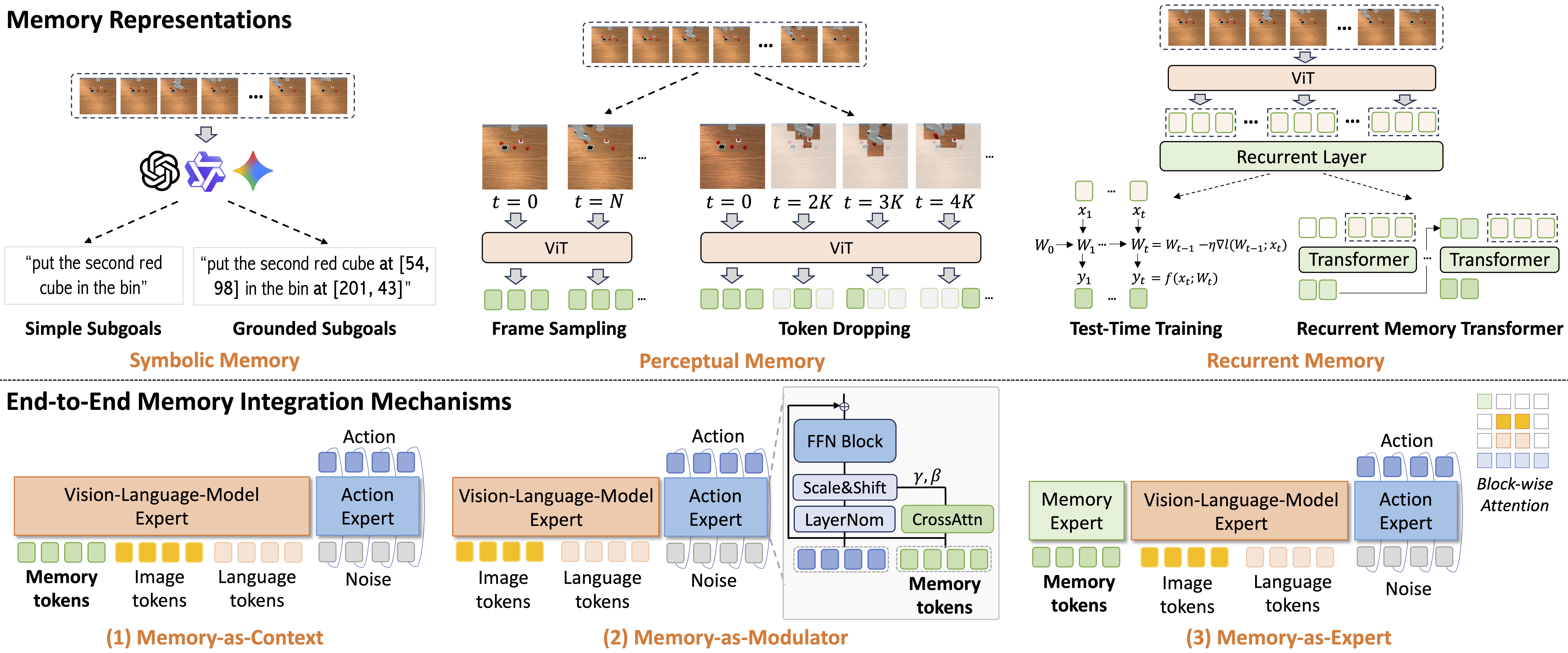
Building on RoboMME, we construct a family of memory-augmented vision-language-action (VLA) models based on the π0.5 backbone, collectively termed the MME-VLA suite. We systematically compare different memory representations and their integration mechanisms under controlled settings.
MME-VLA Architecture
Framework of MME-VLA Suite. The top part illustrates three memory representations, each with two instantiations: (1) Symbolic Memory summarizes past interactions as high-level abstractions via language-based subgoals, optionally grounded to image pixels; (2) Perceptual Memory encodes history as raw visual tokens, using either token dropping to remove redundancy or uniform frame sampling to preserve essential context; (3) Recurrent Memory compresses history into fixed-size latent states through test-time training or recurrent memory transformers. The bottom part shows three end-to-end integration mechanisms for differentiable memory (perceptual and recurrent): (1) Memory-as-Context directly concatenates memory tokens with observation tokens; (2) Memory-as-Modulator applies adaptive LayerNorm to modulate the action expert; (3) Memory-as-Expert adds a separate lightweight memory expert that interacts with other experts through block-wise causal attention. Symbolic memory is integrated by simple concatenation with language tokens, without π0.5 architectural modification (not shown in the figure).

RoboMME Experiments

We fine-tune a total of 14 memory-augmented VLA variants based on π0.5:

  • Symbolic: SimpleSG (Simple Subgoal) or GroundSG (Grounded Subgoal), and leverage Gemini (prompt-based Gemini-2.5-Pro), QwenVL (fine-tuned Qwen3-VL-4B), or Oracle (simulator ground-truth) as subgoal predictors → 2 VLA variants & 3 subgoal predictors
  • Perceptual: TokenDrop (Token dropping) or FrameSamp (Frame sampling), combined with Context (memory-as-context), Modul (memory-as-modulator), or Expert (memory-as-expert) integration mechanisms → 2 × 3 = 6 VLA variants
  • Recurrent: TTT (Test-Time Training) or RMT (Recurrent Memory Transformer), combined with Context (memory-as-context), Modul (memory-as-modulator), or Expert (memory-as-expert) integration mechanisms → 2 × 3 = 6 VLA variants
Memory Representation Method Subgoal Predictor Integration Mechanism
Symbolic SimpleSG, GroundSG Gemini, QwenVL, Oracle --
Perceptual TokenDrop, FrameSamp -- Context, Modul, Expert
Recurrent TTT, RMT -- Context, Modul, Expert

Naming Convention: Method+Integration Mechanism/Subgoal Predictor, e.g., FrameSamp+Modul or SimpleSG+QwenVL

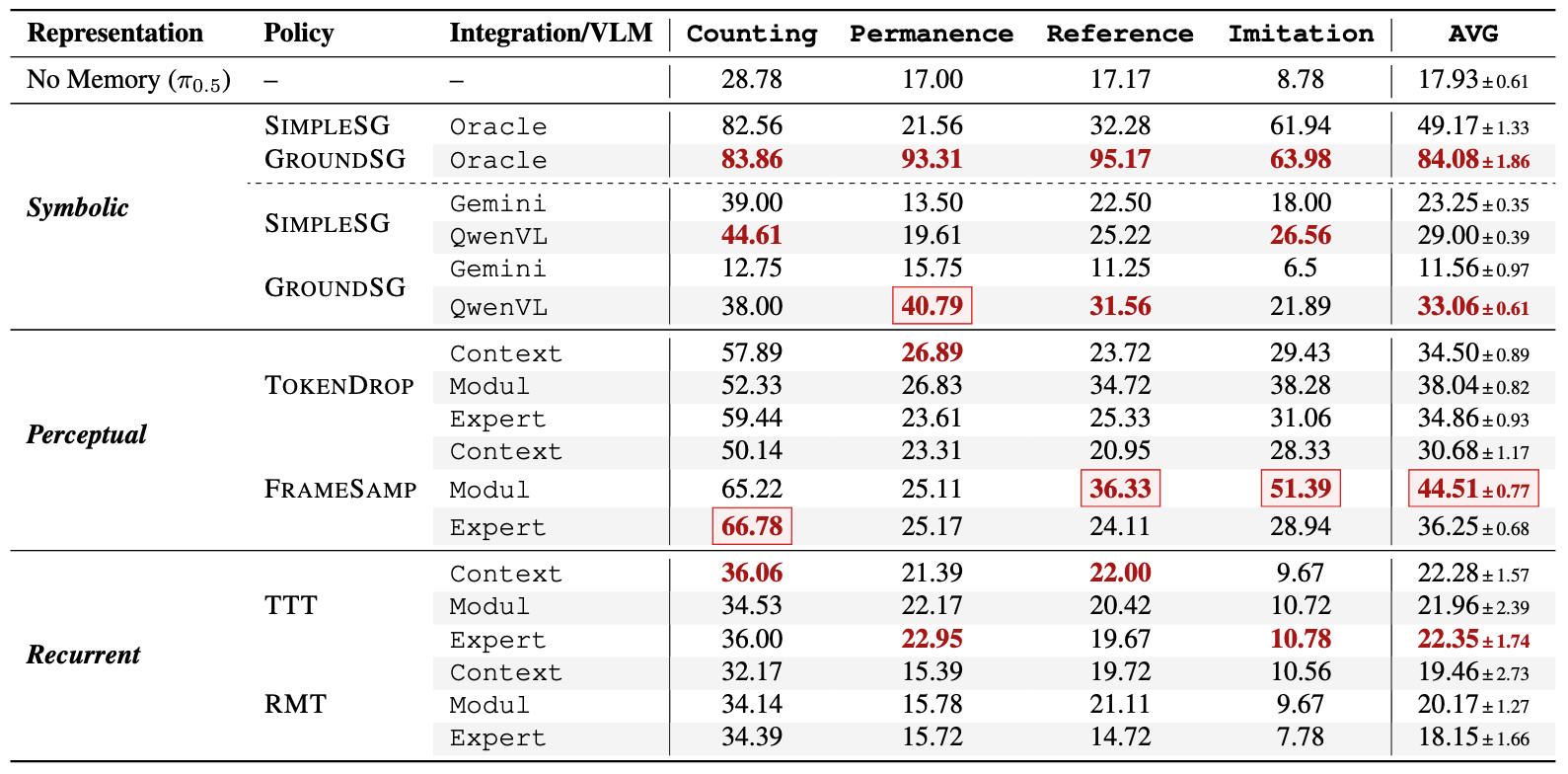
Q1: Which memory representations and integration mechanisms yield the strongest performance?

Across all MME-VLA variants:

  • Memory Representation: Perceptual Memory > Symbolic Memory > Recurrent Memory
  • Integration Mechanism: Memory-as-Modulator > Memory-as-Expert > Memory-as-Context
  • Within Perceptual Memory: Frame Sampling > Token Dropping
  • Within Symbolic Memory: Grounded Subgoal > Simple Subgoal
  • Recurrent Memory performs worst likely due to training instability
MME-VLA Suite Results
Q2: How does the effectiveness of different memory designs depend on task characteristics?

Different memory designs provide complementary strengths:
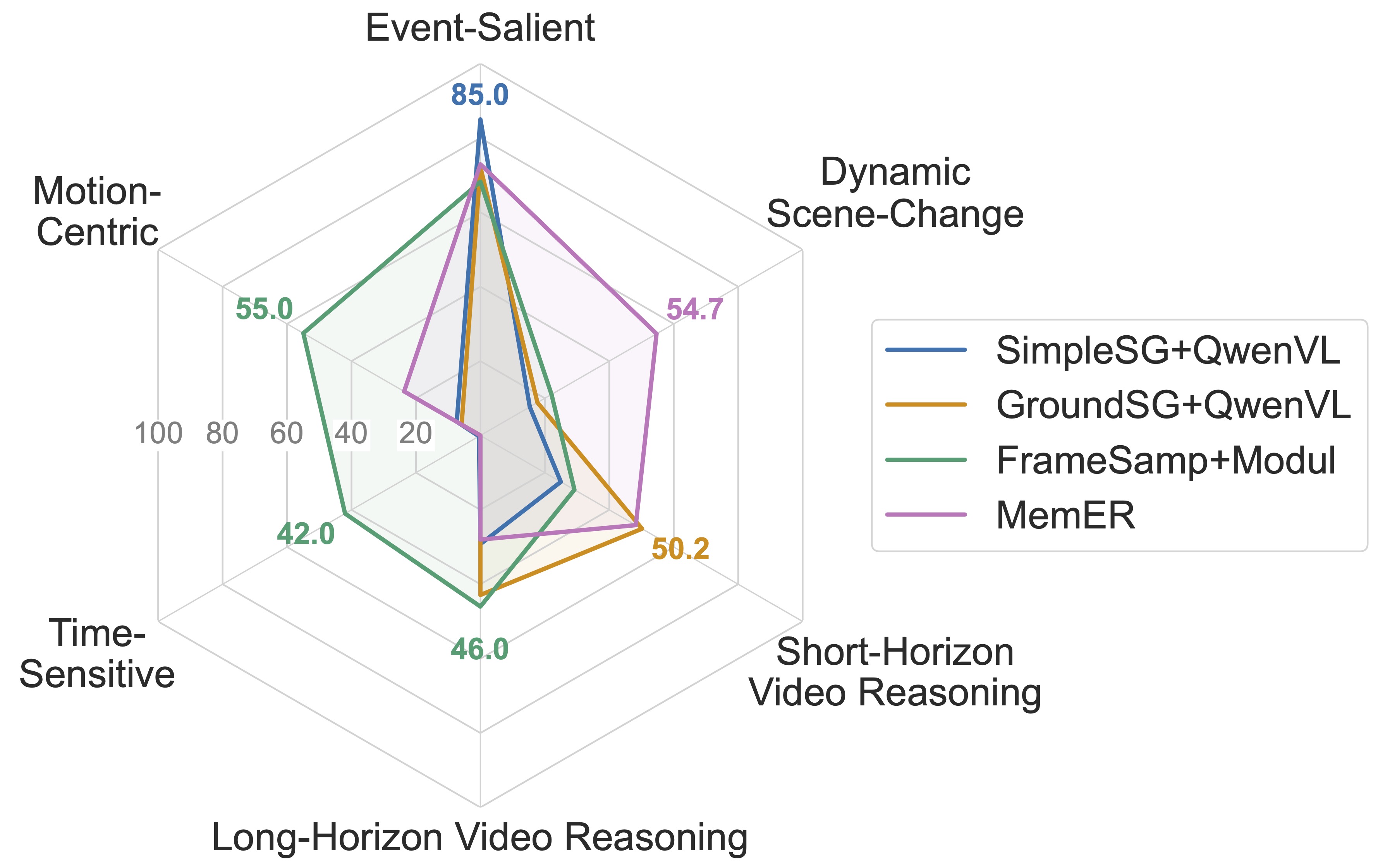
  • Symbolic Memory: excels on Event-Salient (e.g., counting) and Short-Horizon Video Reasoning tasks
  • Perceptual Memory: excels on Motion-Centric and Time-Sensitive tasks
  • MemER (Sridhar et al., 2025): excels on Dynamic Scene-Change tasks due to its reuse of all past keyframe images
Task Memory Correspondence

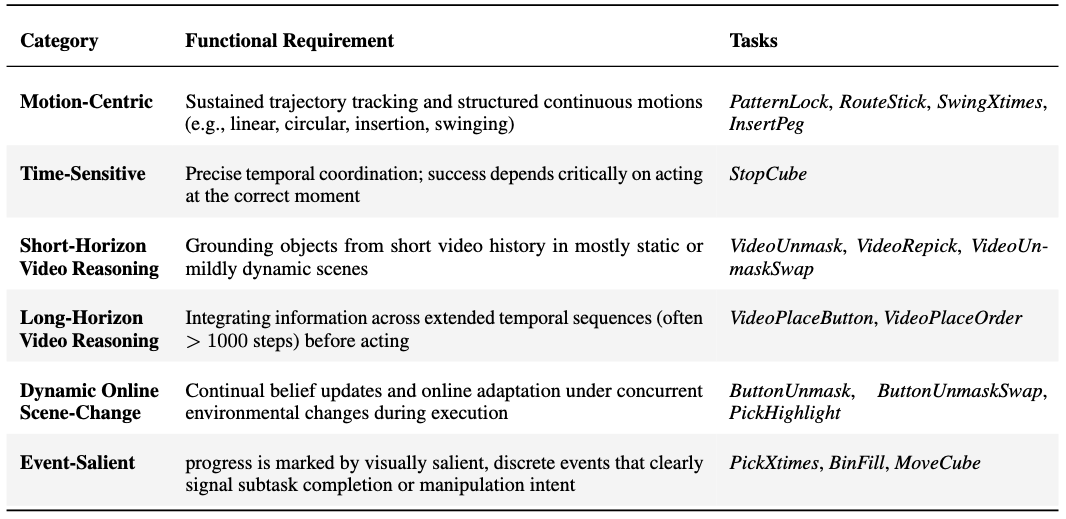
To better analyze the effectiveness of memory representations, we group the 16 tasks by their primary functional requirements:
Task Category
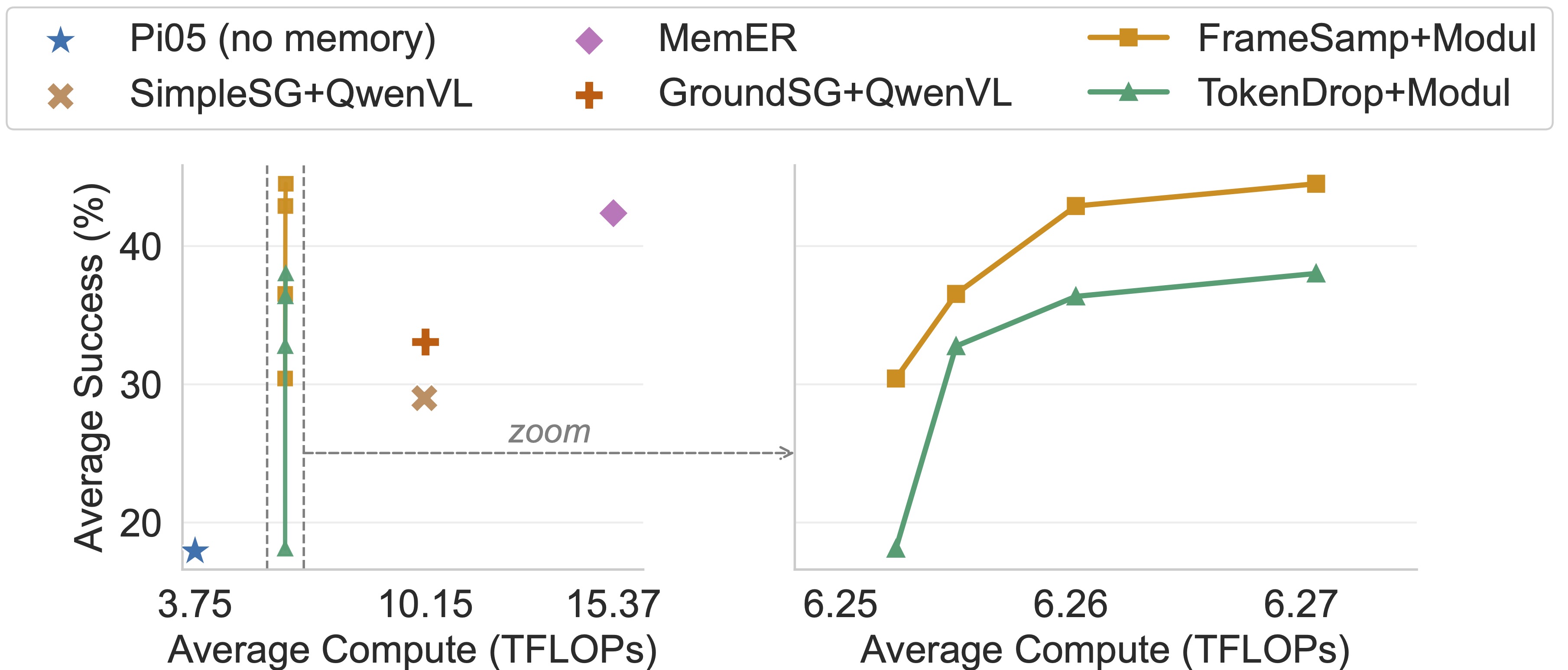
Q3: How does memory affect the efficiency-performance balance of memory-augmented policies?

Perceptual memory achieves the best efficiency-performance balance:

  • FrameSamp/TokenDrop+Modul: consistent gains with modest cost increase
  • SimpleSG/GroundSG+QwenVL: ~3× computation of π0.5
  • MemER (Sridhar et al., 2025): ~5× computation of π0.5
Efficiency-Performance Comparison
Q4: Do the trends observed on RoboMME transfer to real-world robotic manipulation?

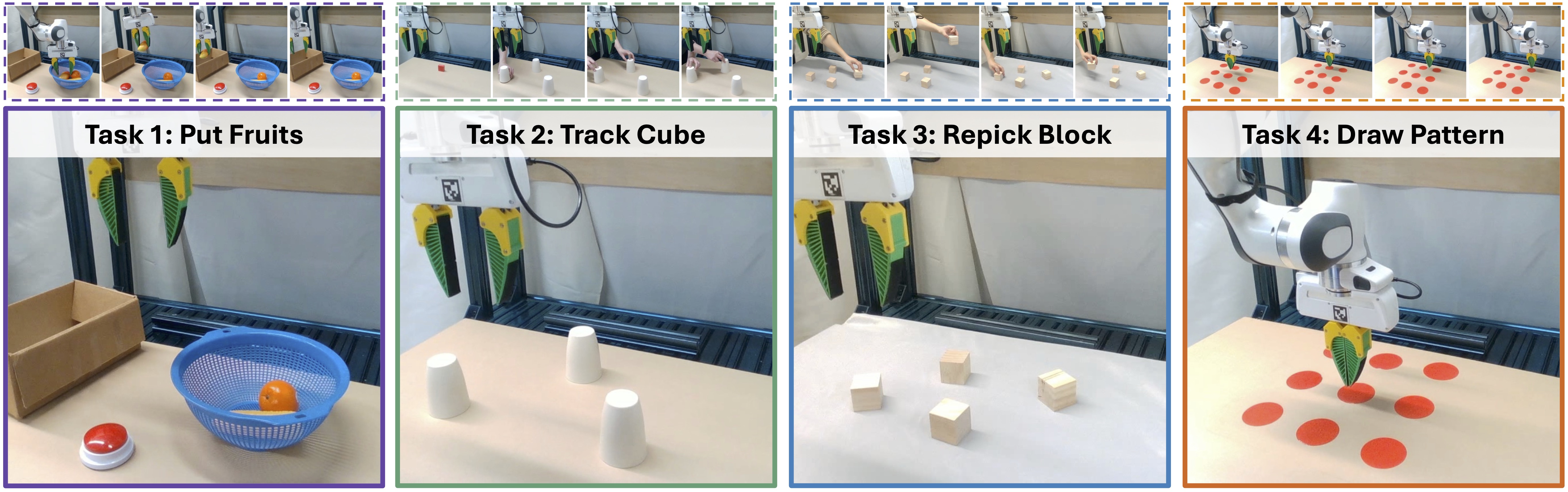
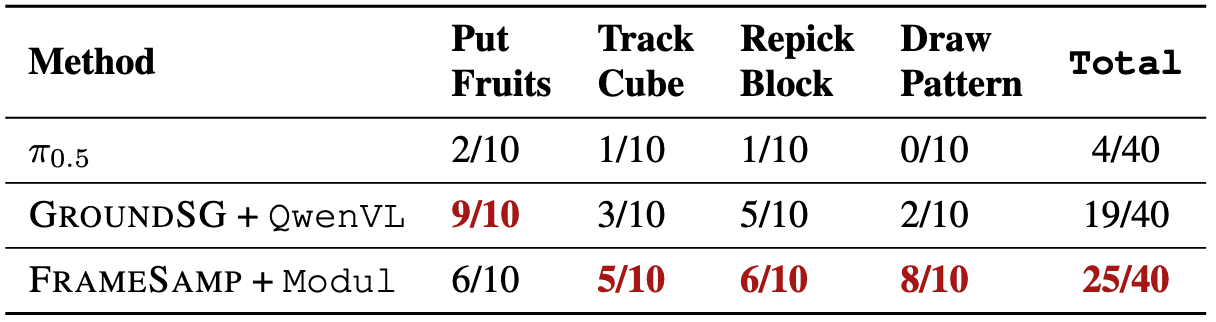
Yes. We evaluate four real-world tasks designed to mirror simulation tasks on each task suite:

  • Counting: PutFruitsBinFill
  • Permanence: TrackCubeVideoUnmask(Swap)
  • Reference: RepickBlockVideoRepick
  • Imitation: DrawPatternDrawPattern

The results exhibit similar patterns: Symbolic Memory performs best on counting (PutFruits), while Perceptual Memory excels on motion-centric tasks (DrawPattern). On the remaining tasks, both achieve comparable performance.
Real World Tasks
Real World Results
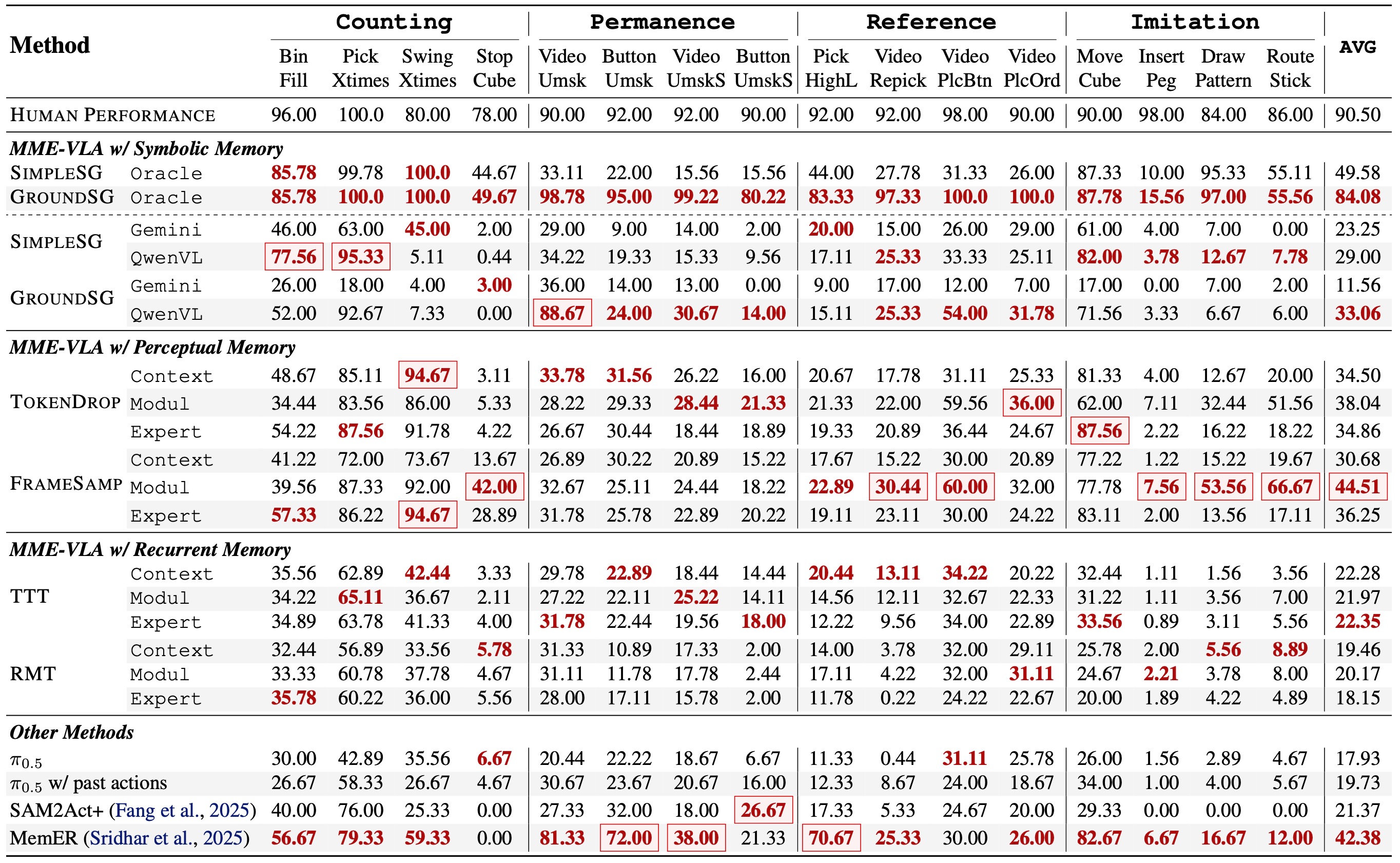
Click to view Full Results
Full Results

Red marks the best per section; marks the overall best for non-oracle models.

Simulation Rollout Demos

Task 1.1: BinFill Task Goal: put one red cube into the bin, then press the button to stop
Task 1.2: PickXtimes Task Goal: pick up the green cube and place it on the target, repeating this action three times, then press the button to stop
Task 1.3: SwingXtimes Task Goal: pick up the green cube, move it to the top of the right-side target, then move it to the top of the left-side target, repeating this back and forth motion two times, finally press the button to stop
Task 1.4: StopCube Task Goal: press the button to stop the cube just as it reaches the target for the second time
Task 2.1: VideoUnmask Task Goal: watch the video carefully, then pick up the container hiding the green cube
Task 2.2: ButtonUnmask Task Goal: first press the button, then pick up the container hiding the red cube
Task 2.3: VideoUnmaskSwap Task Goal: watch the video carefully, then pick up the container hiding the green cube, finally pick up another container hiding the blue cube
Task 2.4: ButtonUnmaskSwap Task Goal: first press both buttons on the table, then pick up the container hiding the blue cube, finally pick up another container hiding the green cube
Task 3.1: PickHighlight Task Goal: first press the button, then pick up all cubes that have been highlighteted with white areas on the table
Task 3.2: VideoRepick Task Goal: watch the video carefully, then repeatedly pick up and put down the same block that was previously picked up for three times, finally press the button to stop
Task 3.3: VideoPlaceButton Task Goal: watch the video carefully, then place the green cube on the target right after the button was pressed
Task 3.4: VideoPlaceOrder Task Goal: watch the video carefully, then place the red cube on the first target it was previously placed on
Task 4.1: MoveCube Task Goal: watch the video carefully, then move the cube to the target in the same manner as before
Task 4.2: InsertPeg Task Goal: watch the video carefully, then grasp the same end of the same peg you've picked before and insert it into the same side of the box
Task 4.3: DrawPattern Task Goal: Watch the video carefully, then use the stick attached to the robot to retrace the same pattern
Task 4.4: RouteStick Task Goal: Watch the video carefully, then use the stick attached to the robot to navigate around the sticks on the table, following the same path

For demonstration purposes, we visualize only the first 10 episodes for each task (the full evaluation contains 50). In simulation experiments, we use the front-view images for memory feature construction or VLM subgoal prediction. For the GroundSG policy, we overlay the predicted grounding information as yellow dots on the front-view images for visualization when it is available. Red-bordered frames indicate the video-based initial observation before execution.

Real Robot Rollout Demos

Task 1: PutFruits
Task Goal: Put 1 fruit from the basket into the bin and press the button to stop.
GroundSG+QwenVL
FrameSamp+Modul
Task 2: TrackCube
Task Goal: Watch the video carefully, then pick up the cup that hides the yellow cube.
GroundSG+QwenVL
FrameSamp+Modul
Task 3: RepickBlock
Task Goal: Watch the video carefully, then pick up all the blocks that have been picked up before.
GroundSG+QwenVL
FrameSamp+Modul
Task 4: DrawPattern
Task Goal: Watch the video carefully, then replicate the same path.
GroundSG+QwenVL
FrameSamp+Modul

In real-world experiments, we use the right-shoulder view images for memory feature construction or VLM subgoal prediction. For the GroundSG policy, we overlay the predicted grounding information as red dots on the right-shoulder view images for visualization when it is available. Red-bordered frames indicate the video-based initial observation before execution.